CUSTOM TECHNOLOGY CONSULTANTS
YOUR LOCAL IT ENGINEER | VETERAN VOICE | CYBERSECURITY | STRATEGY
THE REALITY CHECK: Why New July 2026 Reports Prove the Era of “Giant AI Brains” is Ending
By CHUCK MOORE | Principal Engineer, CTC Published: July 8, 2026
LAS VEGAS, NV — Imagine a massive local construction company that decides to buy the biggest, heaviest, and most expensive semi-truck on the planet. It has a giant engine, it uses a massive amount of fuel, and it looks incredibly powerful.
But when you try to drive it down a normal neighborhood street to deliver a single toolbox, it hits a wall. It is too wide to fit down the road. It burns through a whole tank of gas just to move a block. It destroys the asphalt underneath its tires. And worst of all, the local city council just passed a new law that completely bans giant trucks from driving through residential neighborhoods.
Instead of helping the company work faster, the giant truck turns into a massive, expensive headache that sits in a parking lot.
That is exactly the reality check hitting the artificial intelligence industry this week.
Yesterday, global technology intelligence wires dropped a major mid-year update on the state of AI. For the past three years, big tech giants have been running a frantic race to build the biggest foundation models possible—adding more computer chips and training data to make their software smarter. But this July, the numbers show that the industry has officially hit a physical wall.
The era of simply building “bigger” models is completely over. To survive, the market is aggressively shifting to Post-Training Specialization—building smaller, highly focused, and incredibly efficient AI systems that run on localized networks.
For business owners in Las Vegas, Henderson, and across the Valley, the takeaway is absolute: Stop waiting for a giant, magical cloud brain to solve your corporate problems. True business growth requires building lean, highly secure, and specialized technology in your own office.
The Data Exhaustion: Why More Compute Won’t Save the Hype
To understand why this massive shift is happening right now, leadership must grasp a core rule of modern computing: You cannot train a super-brain if you run out of books to feed it.
For years, software giants relied on old mathematical formulas that said an AI gets smarter the more pre-training data you throw at it. But this summer, researchers confirmed the industry has officially run out of high-quality, human-generated internet data. The token horizons needed to train larger models have become unmanageably long, and the electricity required to power these massive systems is pushing regional utility grids to their absolute limits.
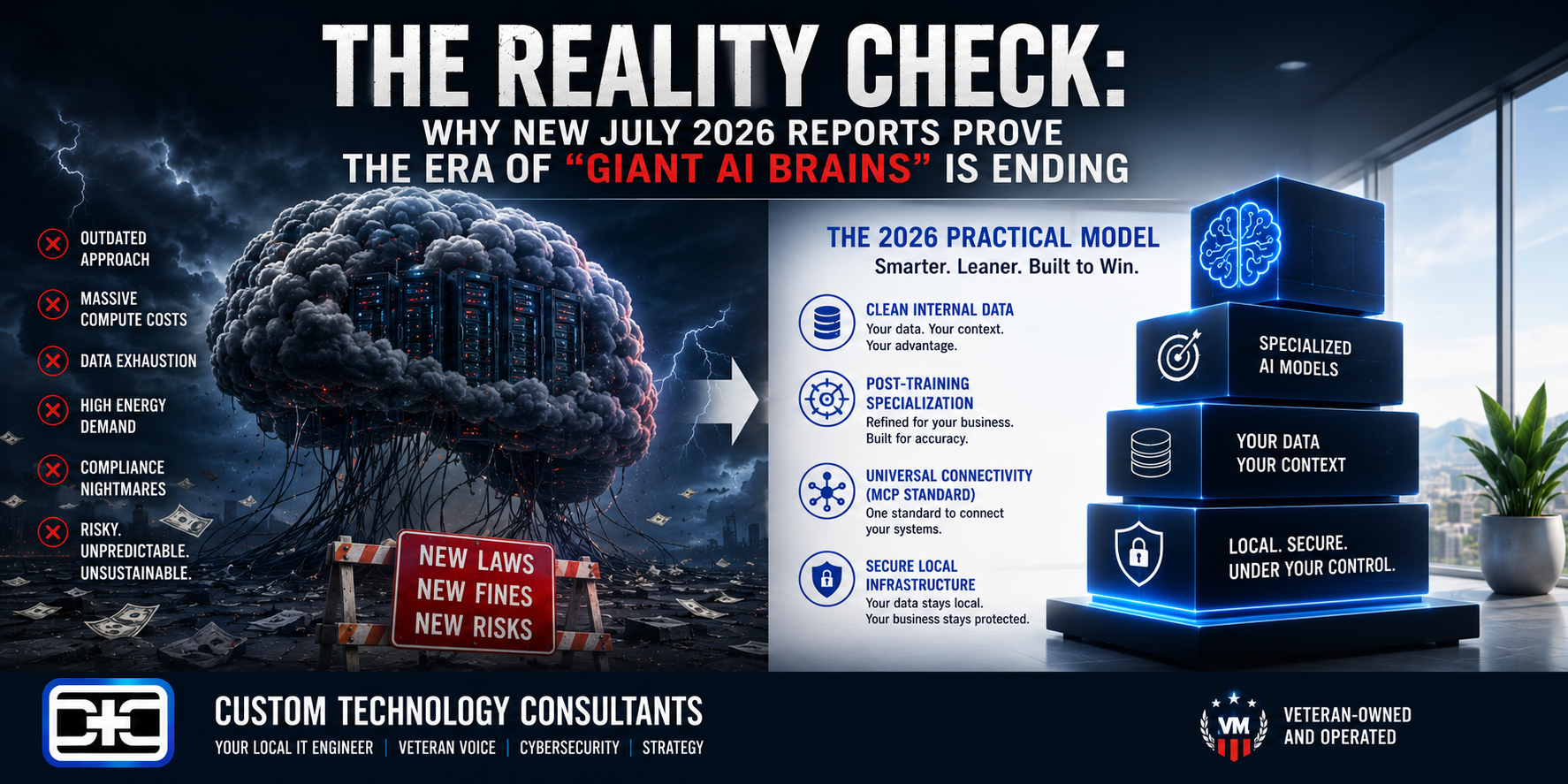
  The Old Hype Model (Bigger & Bulkier):
  [ Millions of Compute Chips ] ──> Giant Public Cloud Brain ──> Extreme Cost & Token Waste 💸

  The 2026 Practical Model (Lean & Specialized):
  [ Clean Internal Data ] ──> Post-Training Refinement ──> Lightning Fast, Secure Execution 📈
Because building bigger models is no longer working, tech innovators are pouring their resources into Post-Training Techniques like reinforcement learning. Instead of trying to teach a machine everything about human history, they are taking smaller, localized models and refining them with specialized internal corporate data.
This means a lean, 12-billion parameter model trained exclusively on your specific company playbooks, billing history, and client records will operate significantly faster, cheaper, and more accurately than a generic, multi-trillion parameter cloud chatbot.
The Compliance Patchwork: The Rising Wall of Local Laws
The other major roadblock forcing companies to ditch giant, public cloud tools is a massive wave of localized legal regulations.
According to a fresh July 1 legislative audit by NYU’s Center on Technology Policy, 29 states have collectively enacted 109 new AI laws and 28 data center regulations over the first half of this year alone. Rather than waiting for a single federal rule, local governments are passing a complicated patchwork of restrictions covering everything from algorithmic dynamic pricing to strict consumer data privacy.
If your business is letting employees blindly drop customer information into public, unmanaged web tools, you are stepping directly into a massive legal minefield. These new laws carry heavy financial penalties for data leakage. True operational protection requires establishing an ironclad, private perimeter where your data never leaves your sight.
The Master Blueprint: Three Steps to Lock Down a Specialized Network
Dismantling this software chaos and making sure your local business stays secure and highly efficient requires moving away from public cloud tools and focusing on three core infrastructure pillars:
- Airtight Internal Data Architecture (RAG): Cleaning and indexing your corporate records, contracts, and spreadsheets locally. This allows secure, private automation tools to look at accurate company files instead of drawing blank hallucinations from public internet search clouds.
- Universal Model Connectivity (MCP Standard): Deploying open-source Model Context Protocols to act as a secure, standardized adapter plug between your data engines and your core software applications, completely eliminating fragile custom code.
- Proactive Resource Virtualization: Running all complex business automation loops inside secure, completely isolated virtual machine (VM) spaces. This keeps your core corporate memory completely immune to software crashes or external system disruptions.
The Trust Factor: Elite Engineering with Veteran Discipline
At Custom Technology Consultants, we don’t look at market updates, shifting regulations, or technological evolutions as a source of confusion, unmanaged liabilities, or unforeseen bills. We engineer your digital infrastructure to serve as a high-performance, predictable asset that completely protects your company memory and accelerates your daily revenue.
With offices in Las Vegas, NV and Clearwater, FL, our specialized systems engineers focus entirely on bespoke strategies—acting as your trusted, part-time fractional technology team to build custom technical setups that match the exact workflow needs of your unique business. Backed by over 40 years of combined IT engineering experience, our veteran-led management team brings military-grade execution, absolute open-book honesty, and top-tier security directly to Southern Nevada’s commercial networks. We handle the hard data plumbing, take care of your regulatory compliance, and wipe out your tech headaches completely in the background—ensuring your technology actively protects your profit while giving your leadership team complete peace of mind.
“The ultimate technical strategy is exceptionally efficient, highly secure, and tailored to your mission,” Moore adds. “We handle the technical battlefield so your leadership can focus entirely on executing your core mission.”
FUTURE-PROOF YOUR OPERATIONAL INFRASTRUCTURE TODAY: Stop letting unmanaged software habits, hidden data leaks, and disjointed IT infrastructure leave your company vulnerable to shifting market dynamics. Take command of your technology assets.
Contact Custom Technology Consultants right now to schedule your FREE Digital Infrastructure Alignment and Local AI Readiness Consultation.
📞 Call or Text Today: 702-209-0252 📧 Email: [email protected] 🌐 Web: www.getcustomtech.com
EDITOR’S NOTES & SOURCES
- The Trustworthy Choice: CTC combines military precision, clear open-book accountability, and advanced technical systems engineering to maximize day-to-day business speed and bulletproof local commercial networks.
- The Mid-Year 2026 State AI Legislative Audit: Comprehensive data from the NYU Center on Technology Policy highlights a 29-state legal framework patchwork consisting of 109 newly enacted AI compliance mandates and 28 local data center ratepayer disclosure boundaries passed since January 1.
- Zero-Trust Strategic Integration: All CTC automation and infrastructure consultations feature a comprehensive data governance pass, ensuring your internal corporate workflows easily satisfy strict modern cyber-insurance and federal privacy underwriting standards.