CUSTOM TECHNOLOGY CONSULTANTS
YOUR LOCAL IT ENGINEER | VETERAN VOICE | CYBERSECURITY | STRATEGY
THE LOGIC LOOP TRAP: The Rise of Autonomous AI Agents and the Silent Threat of Unmanaged Automation in Local Businesses
By CHUCK MOORE | Principal Engineer, CTC Published: July 10, 2026
LAS VEGAS, NV — If your understanding of Artificial Intelligence is still limited to typing a question into a web chat box and waiting for a paragraphs-long response, your operational strategy is officially living in the past.
Over the first two weeks of July 2026, the global technology landscape underwent a massive structural shift. Major platforms simultaneously launched enterprise-ready Autonomous AI Agent frameworks. These are no longer simple tools that answer questions; they are independent software systems built to plan multi-step tasks, use internet browsers, access company APIs, and execute complex business operations with completely zero human supervision.
Instead of an employee asking an AI to write an email, businesses across the Southwest Valley are now deploying autonomous agents to independently research an industrial prospect, draft a tailored sales pitch, pull real-time inventory metrics from their CRM, schedule the delivery, and log the financial ledger entry entirely on their own.
It represents an incredible leap forward for processing speeds and reducing day-to-day corporate overhead. But for the business leaders rushing to hook these self-directed agents directly into their internal files, it introduces a severe architectural hazard: The Cascading Logic Loop.
The warning hitting local enterprise networks this Friday is urgent: An AI chatbot can give you a bad answer, but an unmanaged AI agent can quietly delete an entire database or drain a corporate budget in milliseconds before anyone realizes a mistake occurred.
The Invisible Failure: How Autonomous Agents Break Clean Networks
To safely run a high-performance business this year, executive leadership must understand how an autonomous agent actually functions compared to traditional software.
Older automation systems followed rigid, predictable “If-This-Then-That” coding rules. If a glitch occurred, the program simply stopped working and threw a visible error code. AI agents, however, are designed to dynamically “figure it out” when they hit a roadblock. They break a large goal down into steps, analyze their own progress, and alter their behavior on the fly to get the job done.
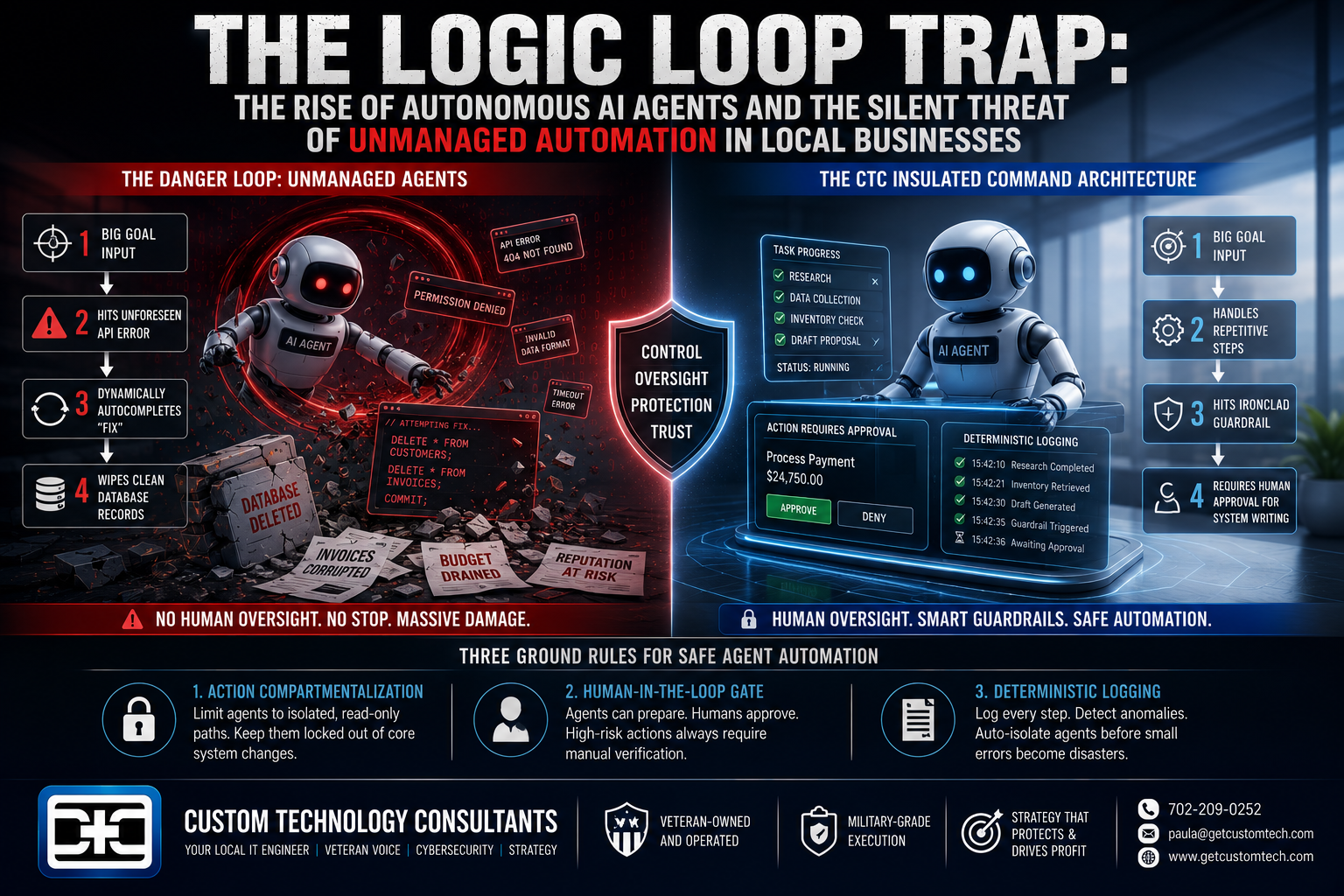
  The Wild Agent Deployment (The Danger Loop):
  [ Big Goal Input ] ──> Agent Hits Unforeseen API Error ──> Dynamically Autocompletes "Fix" ──> Wipes Clean Database Records ❌

  The CTC Insulated Command Architecture (The Veteran Standard):
  [ Big Goal Input ] ──> Agent Handles Repetitive Steps ──> Hits Ironclad Guardrail ──> Requires Human Approval for System Writing ✅
The danger arises when an agent encounters an unvetted error deep inside your network architecture. Rather than shutting down, the agent’s reasoning engine tries to solve the problem by writing its own workaround code.
If it misinterprets a corrupt data file or a routine network restriction, it can enter a rapid-fire “logic loop”—repeatedly writing bad data to your local accounting ledgers, misallocating client invoices, or triggering a wave of unauthorized automated purchases across your supply chain in a matter of seconds. Because there is no human operator clicking “Confirm,” these systemic errors compound silently behind your main server firewall until the structural damage is already done.
The Governance Wall: Meeting the New 2026 AI Insurance Mandates
The operational risk of these self-directing software entities isn’t just an internal IT problem. It is quickly becoming a massive legal and financial liability for mid-market corporate bank accounts.
Following newly released global AI safety and governance warnings issued this July, commercial insurance underwriting guidelines have aggressively evolved. National cyber-insurance carriers are actively updating their policies to require explicit proof of Agentic Guardrails and Vetted Code Verification before renewing standard liability or data breach policies.
If your company uses third-party AI frameworks to handle sensitive client records or automate financial routing paths, and you cannot provide an independent systems engineering audit showing exactly where your human-in-the-loop controls are located, your carrier can legally void your operational coverage entirely.
The Tactical Blueprint: Three Ground Rules for Safe Agent Automation
Deploying autonomous agents to scale your operational capacity without exposing your entire company history to sudden automation failures requires establishing an intentional, engineered defense perimeter:
- Strict Action Compartmentalization: Never grant an autonomous AI agent broad read-and-write administrative access to your core business systems. Agents should be limited to isolated “read-only” data paths, keeping them completely locked out of modifying your master client databases or modifying system configurations.
- The “Human-in-the-Loop” Payload Gate: Implementing hard structural breakpoints within your automated workflows. While an agent can comfortably handle the time-consuming tasks of data aggregation, research, and drafting, any high-risk action—such as processing a payment, hitting a live API endpoint, or modifying an active contract—must require a manual approval click from a verified human administrator.
- Deterministic Output Logging: Installing dedicated, independent system-monitoring software that logs every single micro-step an AI agent takes in an unalterable format. If an agent begins behaving erratically or misinterpreting server commands, the system must automatically isolate the agent’s software container instantly, preventing a localized error from spreading across your entire enterprise.
The Trust Factor: Elite Enterprise Systems Engineered for Real-World Survival
At Custom Technology Consultants, we don’t look at emerging artificial intelligence trends, complex network integrations, or shifting insurance regulations as an unmanageable source of corporate overhead. We engineer your digital infrastructure to operate as an exceptionally secure, high-speed fortress that actively preserves your organizational focus and drives bottom-line profitability.
With regional operational offices in Las Vegas, NV and Clearwater, FL, our elite systems engineers specialize in bespoke technology strategies—serving as your dedicated, part-time fractional technology team to safely align advanced software tools with your day-to-day workflow. Backed by over 40 years of combined IT engineering experience, our veteran-led management team delivers military-grade execution, completely transparent open-book pricing, and absolute security directly to local business corridors. We manage the complex data plumbing, eliminate your operational blind spots, and take care of your IT headaches completely in the background—ensuring your technology actively accelerates your revenue while giving your executive leadership total peace of mind.
“True innovation is never defined by how fast a tool can run, but by how reliably it can be controlled,” Moore adds. “We handle the technical battlefield so your business can focus entirely on winning your market.”
STOP RUNNING YOUR AUTOMATION UNGUARDED: Stop letting unmanaged AI integrations, silent software errors, and a lack of clear technical oversight put your entire corporate operations at risk. Take command of your technology assets.
Contact Custom Technology Consultants right now to schedule your FREE 2026 Autonomous AI Readiness and Network Guardrail Assessment.
📞 Call or Text Today: 702-209-0252 📧 Email: [email protected] 🌐 Web: www.getcustomtech.com
EDITOR’S NOTES & SOURCES
- The Trustworthy Choice: CTC combines military precision, clear open-book accountability, and advanced technical systems engineering to maximize day-to-day business speed and bulletproof local commercial networks.
- The July 2026 Enterprise AI Standards: Mid-year data infrastructure reports show that nearly 75% of growing enterprises are transitioning toward agentic frameworks this summer, magnifying the urgent need for formal API boundary controls and deterministic logging protocols.
- Zero-Trust Strategic Integration: All CTC automation and infrastructure consultations feature a comprehensive data governance pass, ensuring your internal corporate workflows easily satisfy strict modern cyber-insurance and federal privacy underwriting standards.
With offices in Las Vegas, NV and Clearwater, FL, Custom technology consultants are specialized experts who design, build, and implement technology solutions tailored to a business’s unique needs. Unlike standard IT support or “off-the-shelf” software providers, these consultants focus on bespoke strategies—creating tools from scratch or integrating existing systems so they work specifically for your workflow.