CUSTOM TECHNOLOGY CONSULTANTS
YOUR LOCAL IT ENGINEER | VETERAN VOICE | CYBERSECURITY | STRATEGY
THE “LEARNING DEBT” TRAP: Why Buying Expensive AI Software Won’t Save Your Workforce
By CHUCK MOORE | Principal Engineer, CTC Published: August 5, 2026
LAS VEGAS, NV — Corporate America is pouring unprecedented capital into digital transformation. Across the United States, corporate training budgets surged past $100 billion this year, driven by a mad dash to equip employees with generative software tools.
Yet, enterprise data reveals a shocking structural disconnect: 63% of business executives cite deep internal skill gaps as their biggest barrier to growth, while 74% admit their workforce training is falling behind the pace of new technology.
Even worse, corporate adoption studies show that 42% of major AI projects were quietly abandoned over the past year.
The problem isn’t that your employees refuse to learn. The problem is a dangerous operational condition called Learning Debt—the silent, compounding gap that occurs when the pace of new software adoption outpaces your team’s structural capacity to receive proper training.
Dump software tools onto an overloaded workforce without a clear educational blueprint, and productivity plummets. To fix this gap, mid-market companies are replacing generic video libraries with Fractional CTO guidance to build targeted, skills-first workforce training pipelines.
1. The Three Common Causes of Corporate “Learning Debt”
When executive teams buy expensive software licenses without an expert educational strategy, three operational failures occur:
- 1. The “Self-Taught” Tech Trap:Over 56% of employees report being left completely on their own to learn emerging software tools. When staff must figure out complex platforms by trial and error, they develop inefficient workarounds that slow down operations.
- 2. The Vanity Metric Illusion:Relying on traditional video courses that reward simple quiz completion does not create real-world skills. Passing a multiple-choice test is not the same as safely executing a type-safe database query or protecting client privacy.
- 3. The “Shadow AI” Security Breach:When staff are given software tools without clear usage guidelines, they often paste private company documents into unvetted consumer apps to save time—exposing client data to outside servers.
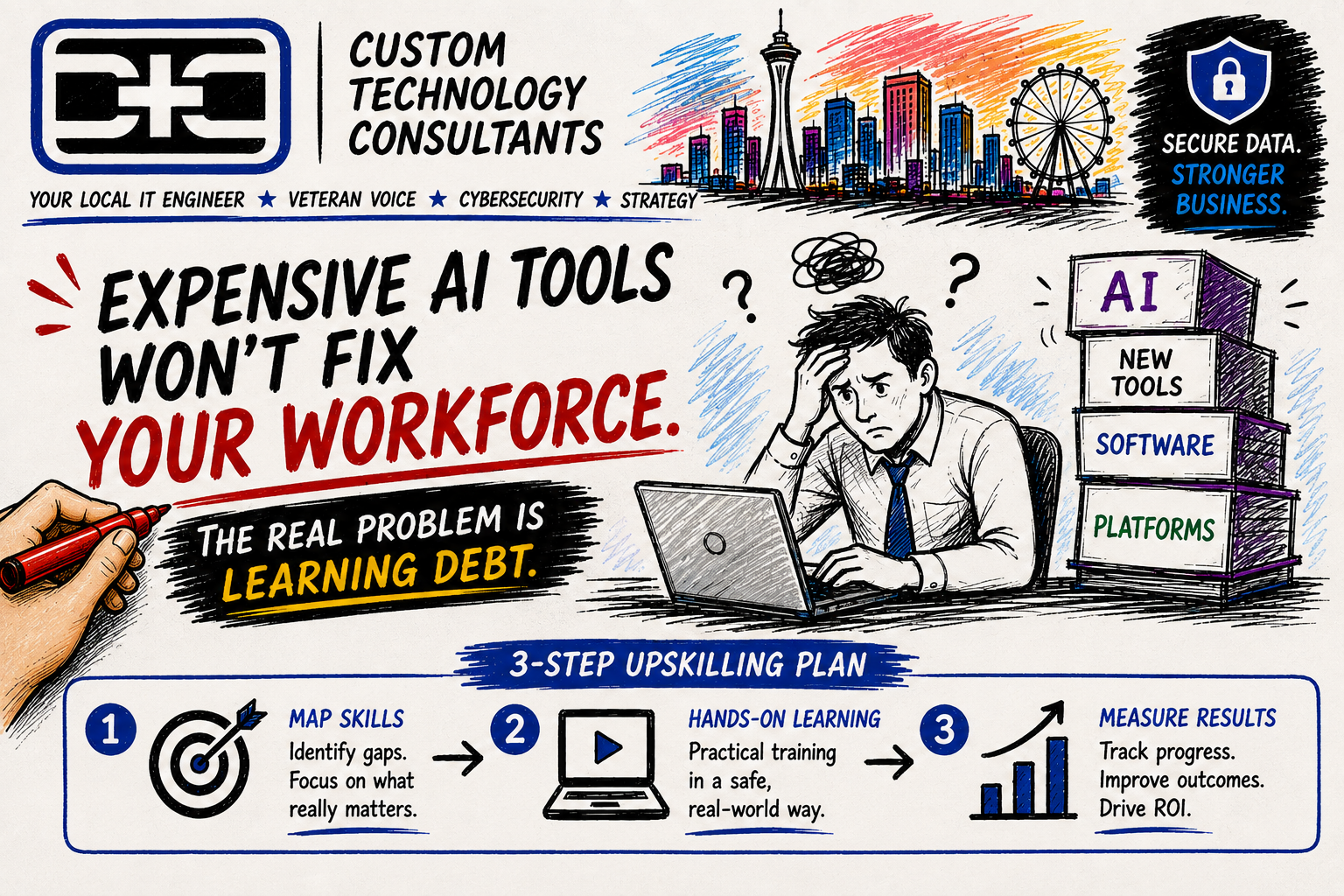
2. The 3-Step Execution Blueprint for Hands-On Upskilling
Modern enterprise education isn’t about sitting in an auditorium for eight hours; it is about micro-learning embedded directly into daily operations.
1
Audit Real Skill Requirements
Step 1: Role Mapping
Stop buying identical software seats for every department. Map out the precise technical tasks required for specific roles—ensuring your accounting team isn’t wading through developer tools.
2
Deploy Micro-Learning & Sandboxes
Step 2: Practical Drills
Replace hours-long lectures with 5-to-15-minute hands-on practice modules. Allow employees to practice new digital workflows inside safe, isolated testing environments before touching live client databases.
3
Measure Business KPIs, Not Completion
Step 3: Executive Control
Tie your training metrics directly to financial outcomes—measuring reduced task time, lower error rates, and zero data leaks rather than simple video completion checkmarks.
3. Why You Need a Fractional CTO to Lead Workforce Education
Teaching your staff how to use modern digital tools safely requires executive technical oversight.
A Fractional CTO serves as your part-time technology executive. Instead of paying $350,000+ per year for a full-time CTO, you get senior-level guidance on a flexible monthly retainer to map your technical strategy, lock down data perimeters, and train your workforce.
  The Unguided Approach (Buying Tools Blindly):
  [ Buy Software Seats ] ──> Self-Taught Guesswork ──> Security Leaks & Abandoned Tech ❌

  The Fractional CTO Approach (Structured Upskilling):
  [ Role-Based Mapping ] ──> Targeted Micro-Learning ──> High Productivity & Secured Data ✅
Comparing Strategic Options for Business Leaders
| Capability Metric | Unguided Tool Purchases | Traditional Outdated Training | Fractional CTO Partner (CTC) |
|---|---|---|---|
| Annual Financial Overhead | High risk of wasted monthly fees | $100k+ in generic platforms | Predictable, low monthly retainer |
| Data Security & Safety | High risk of data leaks | Zero security oversight | Military-grade zero-trust policies |
| Workforce Retention | High frustration & turnover | Low engagement | Dramatically higher job satisfaction |
| Measurable ROI | Only 2% deliver true value | Measured by video views | Directly tied to company profit |
The Trust Factor: Plain-English Technical Strategy
At Custom Technology Consultants, we convert complex technical decisions into clear, straightforward plans designed to grow your profit margins.
With regional offices in Las Vegas, NV and Clearwater, FL, our veteran-led team serves as your dedicated Fractional CTO partner. Drawing on over 40 years of combined IT experience, we eliminate software waste, safeguard private company data, and ensure your technology investments deliver proven returns.
STOP RUNNING UNTRAINED DIGITAL SYSTEMS: Take absolute command of your business technology assets today without paying a full-time executive salary.
Contact Custom Technology Consultants now to schedule your FREE 2026 Workforce Tech & Fractional CTO Assessment.
📞 Call or Text Today: 702-209-0252
📧 Email: [email protected]
🌐 Web: www.getcustomtech.com
EDITOR’S NOTES & SOURCES
- The Strategic Advantage: CTC brings military precision and plain-English technical leadership to give growing mid-market companies elite Fractional CTO strategy without full-time executive payroll.
- The 2026 Enterprise Learning Standard: Research shows companies providing targeted, hands-on digital upskilling earn up to 218% higher income per employee compared to those relying on unguided tools.
- Zero-Trust Security Standard: All CTC technical audits enforce strict data governance to ensure internal training pipelines fully satisfy modern cyber-insurance and federal privacy underwriting requirements.