CUSTOM TECHNOLOGY CONSULTANTS
YOUR LOCAL IT ENGINEER | VETERAN VOICE | CYBERSECURITY | STRATEGY
THE AGENTic SHIFT: The 10-Step Engineering Blueprint for Deploying Enterprise AI Agents From Scratch
By CHUCK MOORE | Principal Engineer, CTC Published: July 23, 2026
LAS VEGAS, NV — The era of static, text-in-text-out chatbots is officially over. Across Southern Nevada, mid-market businesses are shifting away from basic conversational AI toward fully Autonomous AI Agents—software entities capable of executing multi-step business logic, reading complex documents, querying internal databases, and invoking external tools with minimal human supervision.
However, building an AI agent that works in a local test script is radically different from deploying a production-ready agent that won’t break under load, leak sensitive data, or hallucinate execution parameters.
When engineering autonomous workflows for local enterprise environments, technical leaders must move past simple prompt engineering and build structured, resilient systems.
Here is the definitive 10-Step Architectural Roadmap to build, secure, and deploy enterprise AI agents from scratch in 2026.
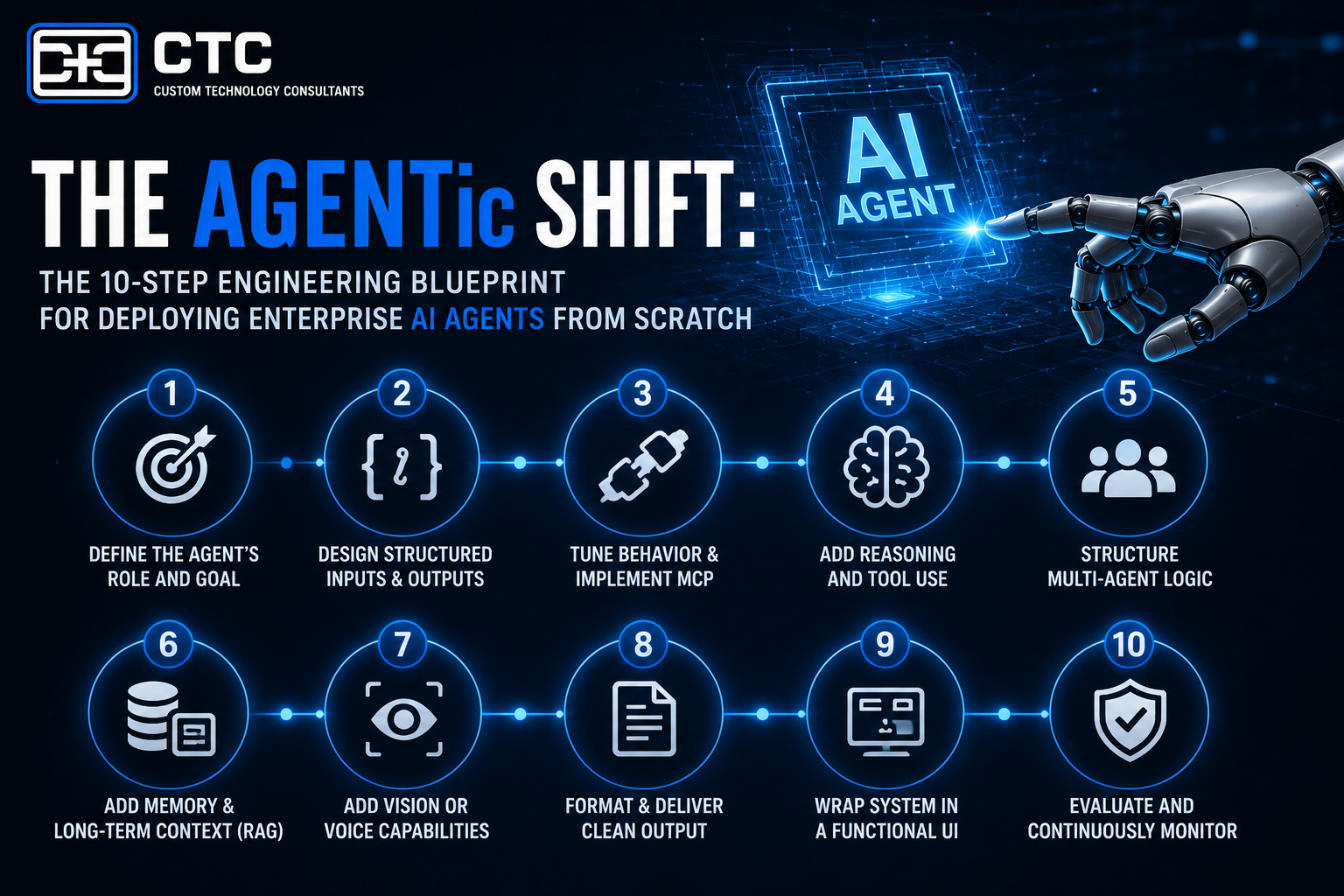
1. The 10-Step Agent Lifecycle Blueprint
To turn generative AI into a predictable, type-safe business asset, engineering teams must follow a structured pipeline that enforces hard privilege boundaries and deterministic data validation at every layer:
1
Define the Agent’s Role and Goal
Step 1: Focus & Inputs
Explicitly define what your agent will do, who it is helping, and what output it must generate. For example, a specialized medical triage assistant reads digital X-rays, summarizes findings, and speaks structured results back to clinical staff.
2
Design Structured Inputs & Outputs
Step 2: Eliminate Raw Text
Never allow agents to output unstructured text blocks into business software. Enforce strict validation using tools like Pydantic AI or JSON Schemas to mandate exact data structures—treating the agent’s logic layer strictly like a type-safe API.
3
Tune Behavior & Implement MCP
Step 3: Protocol Standards
Start with role-based system prompts, prompt tuning, or prefix tuning. Standardize how your agents interface with outside tools and enterprise CRMs by deploying the open Model Context Protocol (MCP) standard.
4
Add Reasoning and Tool Use
Step 4: Systematic Thinking
Equip your agents with structured reasoning frameworks such as ReAct (Reasoning + Action) or Chain-of-Thought. Safely grant access to essential tools like web search, code execution sandboxes, or document retrievers using frameworks like LangChain or OpenAI Tools.
5
Structure Multi-Agent Logic
Step 5: Multi-Agent Networks
When workflows become too broad, divide responsibilities across a specialized “crew”. Use orchestration frameworks like CrewAI, LangGraph, or OpenAI Swarm to assign distinct Planner, Researcher, and Reporter roles with isolated schemas.
6
Add Memory & Long-Term Context (RAG)
Step 6: Stateful Intelligence
For agents that require historical context across sessions, implement conversational memory, summary memory, or vector-based Retrieval-Augmented Generation (RAG) using tools like Zep, LangChain Memory, ChromaDB, or FAISS.
7
Add Vision or Voice Capabilities
Step 7: Multimodal Inputs
Expand capabilities by integrating vision models like GPT-4o or LLaMA 3.2 Vision for document parsing, and text-to-speech tools like ElevenLabs or Coqui to let your agents perceive and respond verbally.
8
Format & Deliver Clean Output
Step 8: Machine Parsing
Ensure all final outputs are formatted cleanly into readable, parsable objects—converting data directly into Markdown, PDFs, or structured JSON using Pydantic AI parsers.
9
Wrap System in a Functional UI
Step 9: Productization
Transform your underlying agent code into a usable business tool by wrapping it in a secure front-end interface using Gradio, Streamlit, or a custom FastAPI microservice.
10
Evaluate and Continuously Monitor
Step 10: Governance
Run automated test prompts and toolchain evaluations to check reliability. Continuously monitor execution logs, trace token usage, and capture user feedback to refine prompt behavior over time.
2. Selecting Your Orchestration Engine
Choosing the correct underlying framework determines whether your system can scale securely inside a corporate network:
  Unstructured Scripting (The Vulnerable Prototype):
  [ User Request ] ──> Generic Unchecked Prompt ──> Hallucinated API Call ──> Silent System Failure ❌

  Type-Safe Agentic Architecture (The CTC Standard):
  [ User Request ] ──> Pydantic Schema Check ──> MCP Tool Boundary ──> Verified Deterministic Output ✅
| Framework | Core Philosophy | Primary Advantage | Best Operational Fit |
|---|---|---|---|
| Pydantic AI | Type-safe, data-first validation built on Python primitives. | Eliminates runtime parsing errors; native async execution. | High-throughput financial, medical, & data-sensitive systems. |
| LangGraph | Graph-based state machine with cyclic control flow. | Complete step-by-step auditability and human-in-the-loop control. | Complex branching logic, compliance, & strict audit workflows. |
| CrewAI | Role-based team coordination model (Researchers, Writers). | Fast prototyping with minimal boilerplate code. | Content pipelines, market research, & specialized sub-teams. |
The Trust Factor: Elite Systems Strategy Engineered for Real-World Growth
At Custom Technology Consultants, we don’t look at complex software integrations, shifting security regulations, or executive technology planning as an unmanageable source of stress. We engineer your digital infrastructure to operate as an exceptionally secure, high-speed fortress that actively preserves your organizational focus and drives bottom-line profitability.
With regional operational offices in Las Vegas, NV and Clearwater, FL, our elite systems engineers specialize in bespoke technology strategies—serving as your dedicated, part-time Fractional CTO partner. Backed by over 40 years of combined IT engineering experience, our veteran-led management team delivers military-grade execution, completely transparent open-book pricing, and absolute security directly to local business corridors. We manage the complex data plumbing, eliminate your operational blind spots, and take care of your IT headaches completely in the background—ensuring your technology actively accelerates your revenue while giving your executive leadership total peace of mind.
“True innovation is never defined by how fast a tool can run, but by how reliably it can be controlled,” Moore adds. “We handle the technical battlefield so your business can focus entirely on winning your market.”
BUILD YOUR AGENTIC INFRASTRUCTURE SAFELY: Stop letting unvalidated AI prototypes, silent logic errors, and loose data permissions put your enterprise systems at risk. Take absolute command of your technology architecture.
Contact Custom Technology Consultants right now to schedule your FREE 2026 AI Agent Architecture & Infrastructure Security Assessment.
📞 Call or Text Today: 702-209-0252
📧 Email: [email protected]
🌐 Web: www.getcustomtech.com
EDITOR’S NOTES & SOURCES
- The Strategic Advantage: CTC combines military precision, clear open-book accountability, and advanced technical systems engineering to give local mid-market businesses elite Fractional CTO strategy without full-time executive overhead.
- The 2026 Agentic Standardization: The widespread enterprise adoption of the open Model Context Protocol (MCP) has established strict new baseline standards for connecting generative engines to external enterprise databases securely.
- Zero-Trust Strategic Integration: All CTC AI agent deployment blueprints include a comprehensive data-governance pass to ensure internal automation pipelines satisfy strict modern cyber-insurance and federal privacy underwriting requirements.