CUSTOM TECHNOLOGY CONSULTANTS
YOUR LOCAL IT ENGINEER | VETERAN VOICE | CYBERSECURITY | STRATEGY
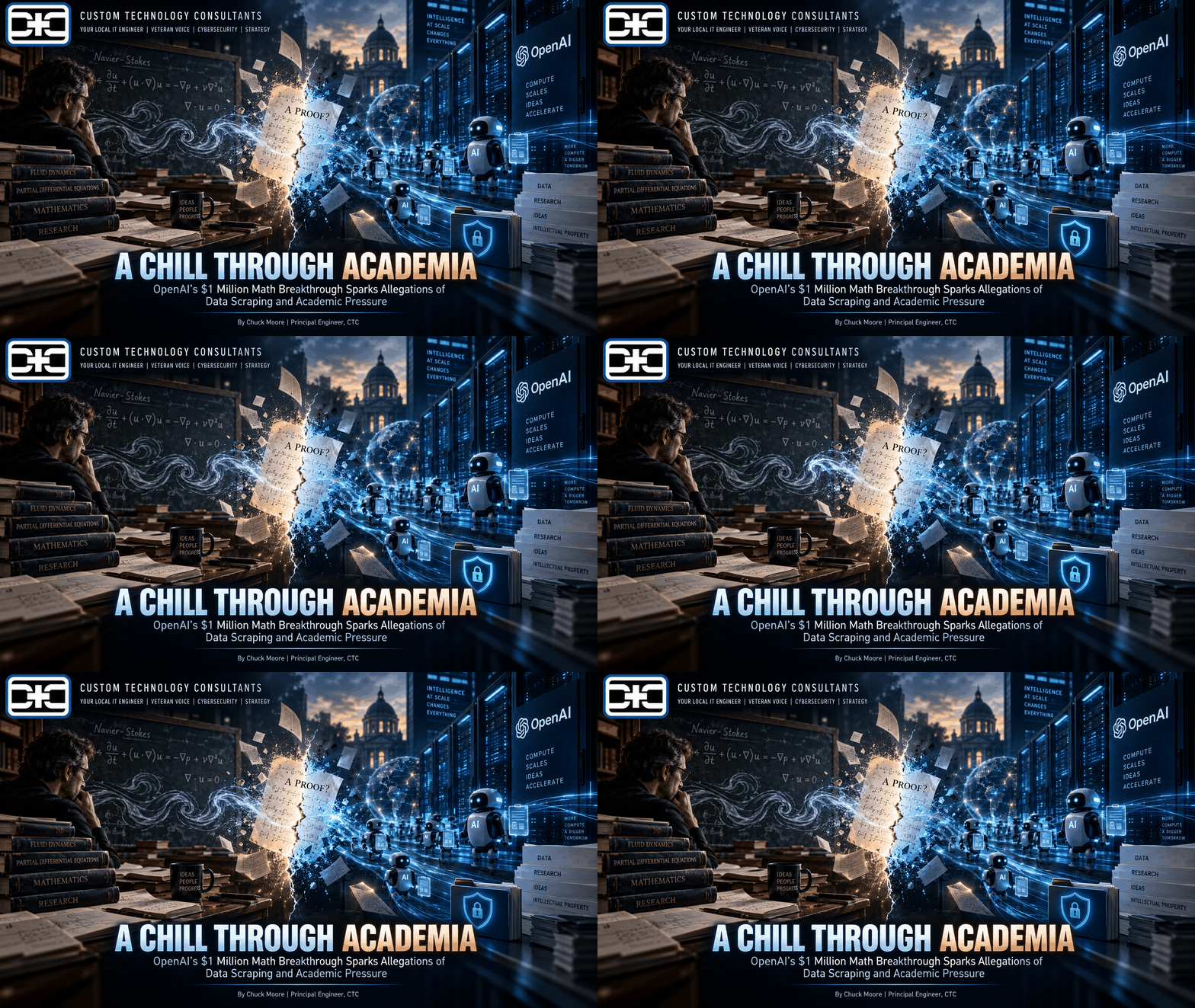
A CHILL THROUGH ACADEMIA: OpenAI’s $1 Million Math Breakthrough Sparks Allegations of Data Scraping and Academic Pressure
By CHUCK MOORE | Principal Engineer, CTC Published: September 17, 2026
LAS VEGAS, NV — The boundary between corporate AI development and traditional academic research dissolved overnight into a high-stakes controversy.
OpenAI sent shockwaves through the global scientific community by announcing it had solved a core component of the Navier-Stokes existence and smoothness problem—one of the prestigious $1 million Millennium Prize Problems established by the Clay Mathematics Institute. Deploying roughly 10,000 autonomous AI agents over 88 hours of continuous compute, the company claimed its system identified a scenario where fluid dynamics equations break down into infinite velocity.
However, the landmark announcement was immediately engulfed in drama. Prominent New York University mathematician Tristan Buckmaster publicly accused OpenAI of rushing to “scoop” his upcoming paper after learning about his progress through shared researchers and cloud tools.
The incident highlights a growing crisis in modern innovation: when corporate AI labs wield massive compute power and cloud access, traditional academic open-source research faces unprecedented competitive risks.
1. The Controversial Race to Break Navier-Stokes
The friction between academic research traditions and rapid AI deployment centers around three major friction points:
  Traditional Human Research:
  Years of Peer Review  -  Open Community Sharing  -  Published Paper

  High-Compute AI Interception:
  Rumors & Cloud Session Signals  -  10,000 Autonomous AI Agents  -  Rapid Scoop
- Allegations of Cloud Monitoring: Buckmaster noted that he used OpenAI tools during his research, leading to suspicions that de-identified user data may have tipped off internal models. OpenAI stated it “cannot rule out” that customer usage data helped improve its internal systems.
- The Death of Open Collaboration: Renowned mathematician Terence Tao warned that the episode creates incentives for academics to stop sharing early research, threatening centuries of open scientific tradition.
- Heavy Compute Brute-Forcing: While human researchers spent years deriving proof frameworks, OpenAI mobilized millions of dollars in compute power to run thousands of parallel AI agents to reach the finish line first.
2. Three Data Privacy Lessons for Business Leaders
While your business may not be solving Millennium Prize equations, the dispute over cloud data usage holds vital lessons for corporate security:
1
Audit External AI Tool Usage
Step 1: AI Data Governance
Ensure staff members are not pasting proprietary code, financial trade secrets, or client files into standard public AI prompts that feed into training datasets.
2
Deploy Enterprise-Grade Isolated Models
Step 2: Private Instances
Utilize private, zero-data-retention cloud instances where vendor models are strictly prohibited from logging or learning from your daily operational data.
3
Maintain Strict Digital Paper Trails
Step 3: Intellectual Property
Timestamp and archive internal designs, custom software code, and research early to prove ownership in the event of IP disputes.
Comparing Academic Research vs. Corporate AI Compute
| Research Environment | Academic Institution Model | Enterprise AI Lab (OpenAI Model) |
|---|---|---|
| Primary Advantage | Deep domain expertise & theoretical rigour | Massive parallel compute & agent fleets |
| Data Transparency | Open pre-prints & community peer-review | Proprietary models & closed datasets |
| Speed to Results | Years of manual paper derivation | 88-hour high-density compute sprints |
| IP Protection | Public trust & attribution protocols | Terms of service & corporate disclosures |
The battle over the Navier-Stokes proof proves that computational power is changing how work gets done. But it also serves as a warning for every business owner: if you put your proprietary ideas and data into unmonitored cloud tools, you lose control over your intellectual property. — Chuck Moore, Principal Engineer at CTC
Practical Technical Leadership & Governance for Your Business
At Custom Technology Consultants, we help local business owners protect their digital assets, secure private company databases, and implement safe AI policies without technical jargon.
With offices in Las Vegas, NV and Clearwater, FL, our veteran-led engineering team acts as your dedicated Fractional CTO partner. We ensure your business communications, customer records, and internal IT infrastructure remain fully protected against data leakage and external risks.
NEED TO SECURE YOUR COMPANY DATA & AI POLICIES?
Contact Custom Technology Consultants today to schedule a FREE Cybersecurity & Data Privacy Review.
📞 Call or Text: 702-209-0252
📧 Email: [email protected]
🌐 Web: www.getcustomtech.com
EDITOR’S NOTES & SOURCES
- Our Mission: CTC provides simple, practical technical leadership to growing businesses without expensive executive payrolls.
- September 2026 Mathematics Disclosures: Case details reference published statements, Clay Mathematics Institute records, and public commentary from NYU, UCLA, and OpenAI research teams regarding the Navier-Stokes proof.