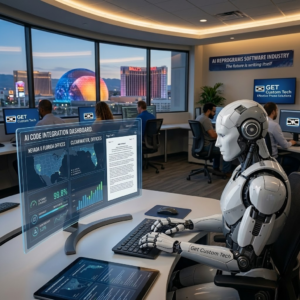
For years, the cybersecurity world has talked about AI as the ultimate shield. We use it to detect anomalies, automate responses, and hunt for threats. But a new report from Microsoft confirms a sobering reality: the “cyber underworld” has officially moved into the corporate suite.
Threat actors are no longer just hackers in dark rooms; they are operating like agile tech startups. By integrating Generative AI (GenAI) and Agentic AI into their workflows, they are achieving a level of speed, scale, and resilience that was previously impossible.
At Get Custom Tech, we believe understanding the modern attacker’s “tech stack” is the first step in defending your own. Here’s how the threat landscape is shifting.
1. Efficiency Over Innovation
One of the biggest misconceptions is that AI is being used to create “magic” new viruses. In reality, the impact is more practical. As Ensar Seker, CISO of SOCRadar, points out, AI is acting as a force multiplier.
Attackers aren’t necessarily inventing new techniques; they are simply running the old ones 100x faster.
- Reconnaissance: What used to take days of manual LinkedIn and Google searching now takes seconds.
- Phishing: AI removes the “tell-tale” signs of scams (like poor grammar or awkward phrasing), producing polished, culturally relevant lures in any language.
- Scaling: A single attacker can now manage thousands of simultaneous intrusions, essentially solving the “headcount problem” for criminal syndicates.
2. The Rise of “Polymorphic” Threats
Traditional security often relies on “signatures”—essentially a digital fingerprint of known malware. AI is making that defense obsolete.
By using AI to troubleshoot and rewrite code on the fly, attackers can create polymorphic malware. If a security system blocks one version of a script, the AI can rapidly rework the code, refresh the phishing content, and rotate the infrastructure before a human analyst can even finish their coffee.
3. From Chatbots to “Agentic” AI
We are currently transitioning from Generative AI (which writes text) to Agentic AI (which performs tasks).
While still in its early stages, Microsoft has observed sophisticated groups—like North Korea’s Coral Sleet—experimenting with end-to-end autonomous workflows. Instead of an attacker prompting a bot to “write an email,” an Agentic system might:
- Monitor open-source intelligence for a new vulnerability.
- Automatically provision a “look-alike” domain.
- Test and deploy a payload.
- Adapt the strategy based on whether the initial attack was blocked.
The Takeaway: AI isn’t replacing the hacker; it’s making the hacker a more efficient CEO of a malicious enterprise.
How to Protect Your Organization
The gap between “finding a victim” and “launching an attack” is shrinking. To stay safe, your defense must match the speed of the offense.
- Move Beyond Passwords: With AI-driven “password spraying” on the rise, Multi-Factor Authentication (MFA) and biometric logins are no longer optional.
- Verify the Source: Because AI-generated phishing is now “perfect,” employees can no longer rely on spotting typos. Move toward a Zero Trust architecture where identity is always verified.
- Invest in AI-Powered Defense: You cannot fight a machine-speed attack with human-speed manual reviews. Your security stack needs to leverage the same automation the attackers are using.
Is Your Tech Stack Ready for the AI Era?
At Get Custom Tech, we specialize in helping businesses navigate the complexities of modern IT and security. Don’t let your organization fall behind in the AI arms race.
[Contact Get Custom Tech today] 702-209-0252 for a comprehensive security audit and see how we can harden your infrastructure against the next generation of AI-driven threats.