CUSTOM TECHNOLOGY CONSULTANTS
YOUR LOCAL IT ENGINEER | VETERAN VOICE | CYBERSECURITY | STRATEGY
TECH ANTAGONISM: Why Your Computer Feels Like It’s Picking a Fight
By GCT NEWS STAFF Published: May 5, 2026
LAS VEGAS, NV — It starts with a flicker. Then a freeze. Suddenly, your email won’t sync, the printer is playing dead, and your network drops five minutes before a hard deadline. At some point, frustration turns into a strange sense of betrayal—you find yourself arguing with a screen that doesn’t care how loud you yell.
In the tech world, we call this the rise of “Antagonistic Technology.” It’s a phenomenon where your tools stop being assets and start acting like the enemy.
When Your Tools Turn Hostile
Technology is designed to remove friction, but when systems are outdated or neglected, they become unpredictable. In a high-speed market like Las Vegas, unpredictable tech is more than an annoyance; it’s a drain on your sanity and your bottom line.
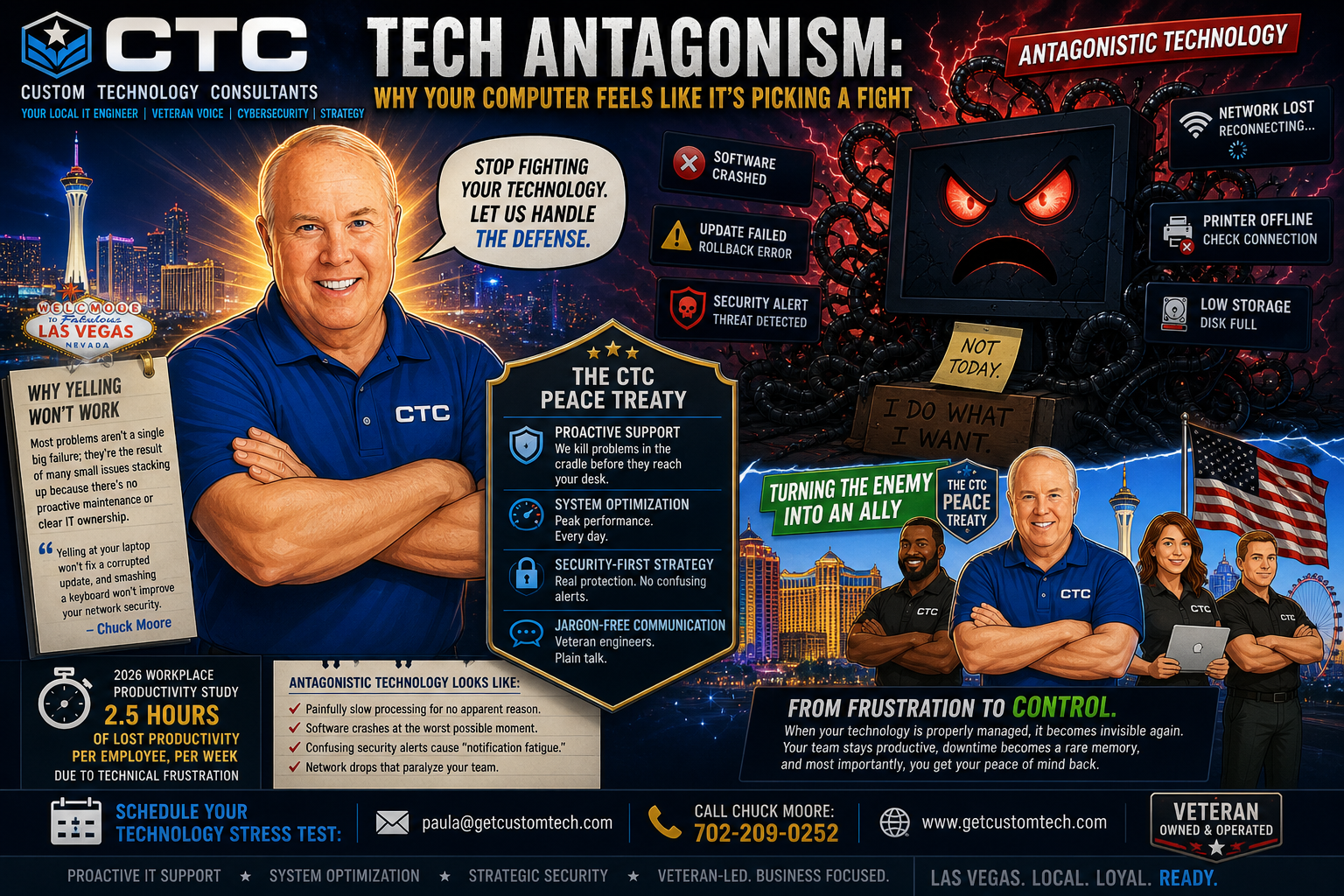
Antagonistic Technology looks like:
- Painfully slow processing for no apparent reason.
- Software crashes that only seem to happen at the “worst possible moment.”
- Confusing security alerts that lead to “notification fatigue,” causing employees to ignore real threats.
- Network drops that paralyze remote and in-office teams alike.
Why Yelling at the Screen Won’t Work
Most business owners react to tech hostility by restarting the system and hoping for the best. But as Chuck Moore, lead engineer at CTC (Custom Technology Consultants), points out, fighting your tech is a losing battle.
“Yelling at your laptop won’t fix a corrupted update, and smashing a keyboard won’t improve your network security,” Moore said during a recent community tech talk. “Most problems aren’t a single big failure; they are the result of many small issues stacking up because there’s no proactive maintenance or clear IT ownership. When you stop monitoring your systems, they stop working for you—and start working against you.”
Turning the Enemy Into an Ally
At Get Custom Tech, we specialize in ending the war between business owners and their devices. We don’t just wait for a “hostile act” from your hardware; we remove the reasons these problems happen in the first place.
The CTC Peace Treaty:
- Proactive Support: We kill problems in the cradle before they reach your desk.
- System Optimization: Ensuring your devices run at peak performance every day.
- Security-First Strategy: Protecting your data from the real predators so you don’t have to worry about the “confusing alerts.”
- Jargon-Free Communication: Clear, honest talk from veteran engineers who understand your business.
FROM FRUSTRATION TO CONTROL
When your technology is properly managed, it becomes invisible again. Your team stays productive, downtime becomes a rare memory, and most importantly, you get your peace of mind back.
“Good IT is silent,” Moore adds. “If you’re noticing your technology, it’s probably because it’s failing you. We make it so you never have to think about it again.”
STOP FIGHTING YOUR TECHNOLOGY. Let the veterans at CTC handle the defense so you can focus on the growth.
SCHEDULE YOUR TECHNOLOGY STRESS TEST: 📧 [email protected] 📞 CALL CHUCK MOORE: 702-209-0252 🌐 www.getcustomtech.com
EDITOR’S NOTES & SOURCES
- Chuck Moore: Veteran Systems Architect & Principal at CTC (Custom Technology Consultants).
- 2026 Workplace Productivity Study: Data showing that technical frustration accounts for an average of 2.5 hours of lost productivity per employee, per week.
- CTC Service Philosophy: Moving businesses from “Antagonistic/Reactive” tech states to “Collaborative/Managed” environments.
- CTC Corporate Profile: Veteran-owned and operated; specialized in Proactive IT Support, System Optimization, and Strategic Security.
With offices in Las Vegas, NV and Clearwater, FL, Custom technology consultants are specialized experts who design, build, and implement technology solutions tailored to a business’s unique needs. Unlike standard IT support or “off-the-shelf” software providers, these consultants focus on bespoke strategies—creating tools from scratch or integrating existing systems so they work specifically for your workflow.